
The term monofilament refers to the type of fiber used in the manufacture of artificial turf. It is a single, continuous and uniform filament, usually straight or slightly curved, that mimics the structure of a blade of natural grass. This type of fiber has become a quality standard in the industry due to its durability, aesthetic realism and superior mechanical behavior compared to other systems such as fibrillated.
Technical characteristics of the monofilament
The monofilament in artificial turf is produced from high-strength polymers, such as polyethylene (PE) or, in some cases, polypropylene (PP). The cross-section of each fiber can vary – diamond, “S”, “C” or “U” shaped – which directly influences its resistance to deformation and its ability to recover after being walked on.
In high-end turf, monofilament fibers usually exhibit:
- High Dtex (measurement of yarn density), which means more material per unit length.
- UV treatments to prevent discoloration with sun exposure.
- Antistatic additives that improve the experience of use in dry climates.
Advantages over fibrillation
Monofilament grass is characterized by maintaining a more natural appearance: each individual fiber reflects light differently, avoiding excessive artificial glare. In addition, being a continuous yarn, it offers:
- Greater mechanical resistance: better withstands wear due to treading and friction.
- Better recovery: fibers return to their original position more easily.
- Increased durability: can exceed 8-10 years of useful life in quality residential installations.
- Less compaction: maintains its volume and aesthetics for a longer period of time.
In comparison, fibrillar fibers – which are divided into multiple thin filaments – tend to flatten and lose volume more rapidly, especially in areas of high traffic.
Most common applications
Monofilament is used in different types of high-end artificial turf:
- Premium gardens and residential areas, where the natural aspect is a priority.
- Professional sports fields (soccer, rugby), where boat resistance and consistency are required.
- Commercial or hotel areas looking for an aesthetic and durable solution.
- Terraces and attics, due to its resistance to extreme weather conditions.
In sports facilities, monofilament is combined with infill systems (silica sand, EPDM) to improve the stability and safety of the playing field.
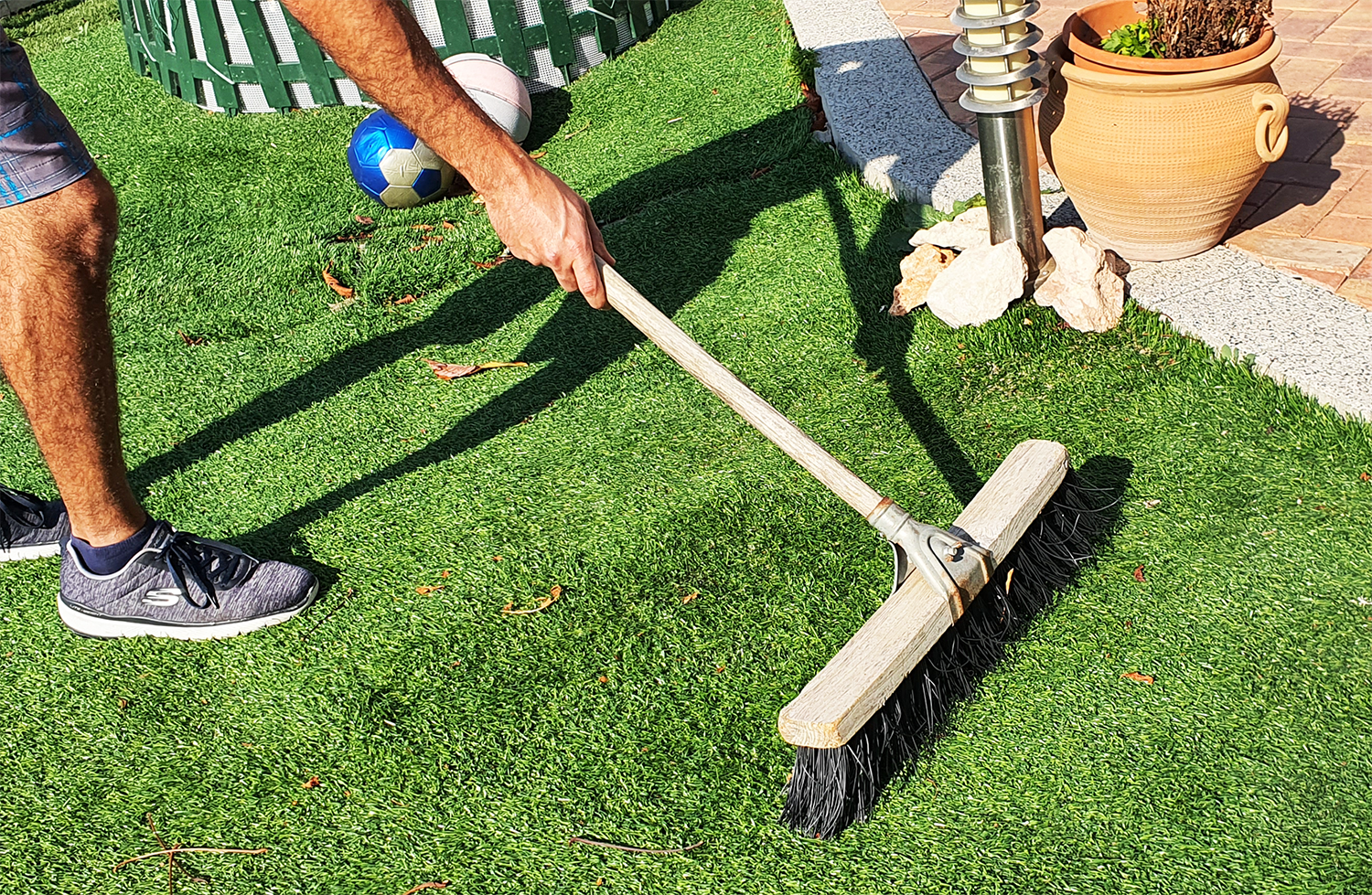
Maintenance of monofilament turf
Although its resistance is high, monofilament turf requires preventive maintenance to maintain its appearance and performance:
- Periodic brushing to lift the fibers and redistribute the filler.
- Cleaning of leaves, dust and organic debris.
- Drainage revision to avoid puddles.
In sports facilities, weekly mechanical brushing and filler replacement according to wear and tear is recommended.
Quality factors to be evaluated
Not all monofilament grasses are the same. To identify a quality product, it is important to pay attention to the following:
- Fiber height: in gardens, 30-40 mm is usually optimal.
- Yarn weight: higher Dtex indicates higher density and strength.
- Section shape: shapes with a central rib (such as “C” or diamond) improve recovery.
- Additional treatments: resistance to UV rays, chlorine, salinity and antistatic properties.
Conclusion
Monofilament is the preferred choice for those seeking a high-performance, natural-looking, long-lasting artificial turf. Its continuous structure, resilience and specific treatments make it an ideal choice for both residential and professional use. By investing in a quality monofilament turf, you not only get a superior aesthetic finish, but also a product capable of withstanding years of intensive use while maintaining its performance.


